
THE CHIEF JUSTICE OF THE SUPREME COURT OUTLINES THREE MAIN PILLARS OF PROFESSIONALISM FOR PROSECUTOR CANDIDATES
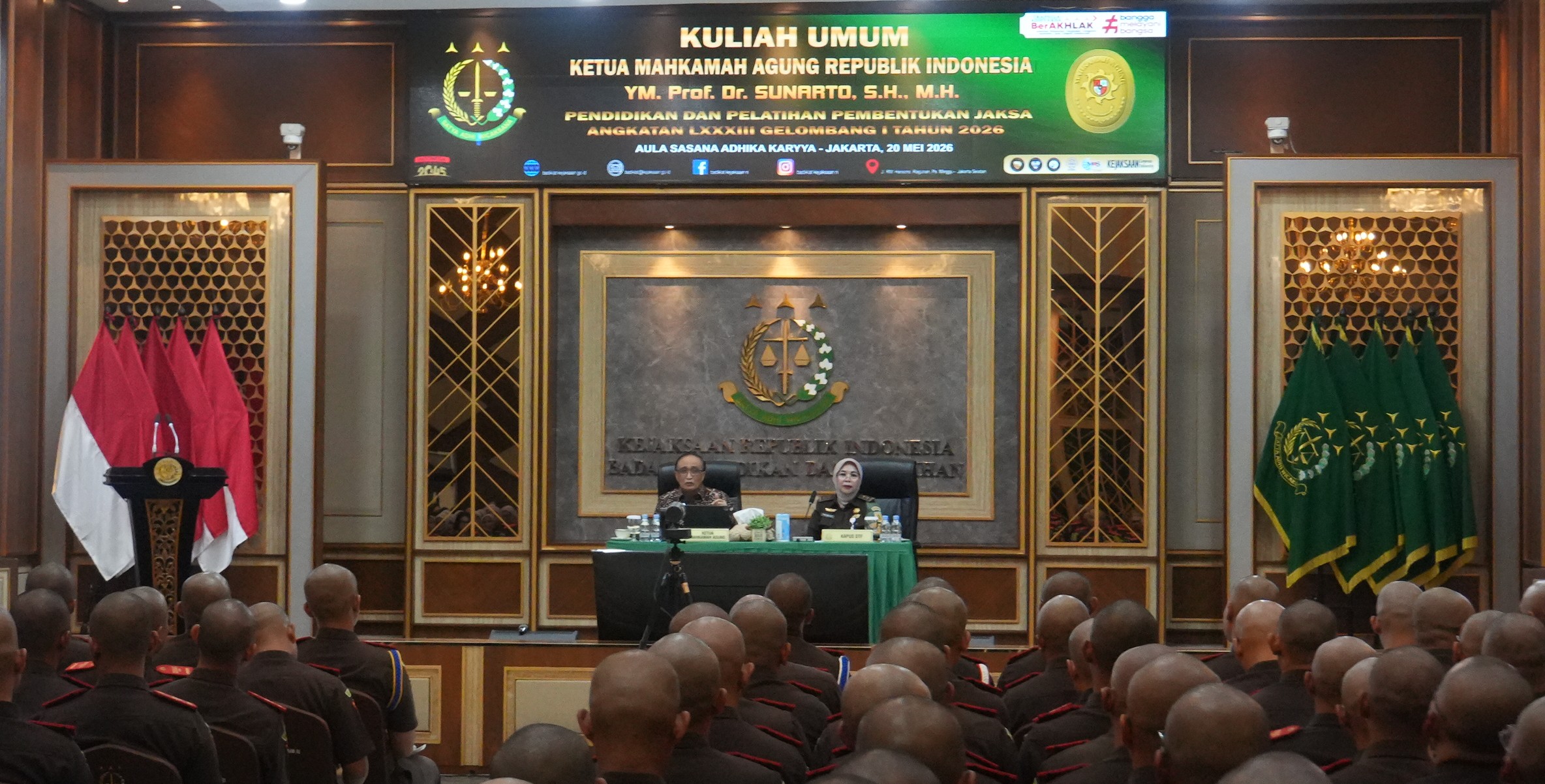
Jakarta – Public Relations: Chief Justice of the Supreme Court of the Republic of Indonesia, Prof. Dr. Sunarto, S.H., M.H., delivered a keynote speech at the 83rd Batch of Prosecutor Training Program in 2026. The event was held at Sasana Adhika Karya, Attorney General’s Office Building, Jakarta, on Wednesday (20/5).
In his remarks, Prof. Sunarto emphasized that the professionalism of law enforcement officers must be grounded in three main pillars: integrity, intellectuality, and capability. According to him, these three pillars play a crucial role in enabling prosecutors to face today’s legal challenges.
“Without integrity, intelligence may deviate into abuse of authority. Conversely, without capability, integrity alone is insufficient to face the challenges of the times,” he explained.
Prof. Sunarto stated that integrity is one of the most fundamental aspects and remains a major challenge in the legal profession. As case controllers, or dominus litis, prosecutors are particularly vulnerable to various temptations and pressures, both internal and external.
“That is why prosecutors must possess strong moral principles and the courage to stand on the side of law, justice, and conscience,” he added.
He further explained that prosecutorial professionalism should not merely be measured by the ability to understand procedural law and conduct prosecutions, but also by a firm commitment to uphold morality, ethics, and social responsibility.
According to him, in carrying out their duties, prosecutors do not only deal with legal texts but also with social issues, victims’ interests, the rights of all parties, and broader social justice concerns.
“The duty of a prosecutor is essentially to provide legal certainty capable of balancing individual interests, victim recovery, and social interests,” said Prof. Sunarto.
On the same occasion, the Chief Justice also emphasized the importance of maintaining a proper relationship between prosecutors and judges.
He explained that prosecutors exercise prosecutorial authority based on law and valid evidence, while courts independently and impartially perform judicial functions to examine, assess, and fairly decide cases.
Therefore, although prosecutors and judges carry out different functions within the criminal justice system, they ultimately share the same objective: upholding law and justice.
“The relationship between prosecutors and judges must be understood proportionally. They are not institutional adversaries, but fellow law enforcers who perform their respective roles within the criminal justice system,” he emphasized.
The Chief Justice also highlighted important reforms introduced under the 2025 Criminal Procedure Code (KUHAP), which reinforce the principle of functional differentiation. This principle clarifies the boundaries between police investigations and inquiries, prosecution by prosecutors, and judicial examination by judges in order to establish a fair and professional justice system.
Referring to the concepts of law in books and law in action introduced by Roscoe Pound, Prof. Sunarto reminded participants that the success of new regulations, such as the 2023 Criminal Code and the 2025 Criminal Procedure Code, largely depends on how legal practices are implemented in reality.
Public trust also became one of the key topics discussed during his speech. Prof. Sunarto stated that in the era of digital transformation and globalization, the greatest challenge for law enforcement institutions lies not only in technical matters, but also in maintaining legitimacy and public trust.
He expressed appreciation for the achievements of the Attorney General’s Office, which has consistently ranked as the most trusted law enforcement institution according to national surveys conducted by Indonesian Political Indicators, recording trust levels ranging from approximately 76 percent to nearly 80 percent.
Furthermore, data from early 2026 showed that the Attorney General’s Office had become the state institution most trusted by Indonesia’s younger generation, with a trust level reaching 60.3 percent. Nevertheless, Prof. Sunarto reminded prospective prosecutors not to become complacent. According to him, public trust that has been built over years can quickly collapse due to the misconduct of only a few individuals.
At the conclusion of his speech, the Chief Justice delivered a message to the training participants as the future generation of the Adhyaksa Corps. He urged them to carry out their duties with humility, prudence, and wholehearted dedication.
“Be humble in viewing your position as a mandate, cautious in exercising your authority, and wholehearted in dedicating yourself to upholding law and justice,” he concluded. (sk/ds/Photo:end,sna/translation: azh)


