
SUPREME COURT AND KPK AGREE ON ZERO TOLERANCE FOR INTEGRITY VIOLATIONS
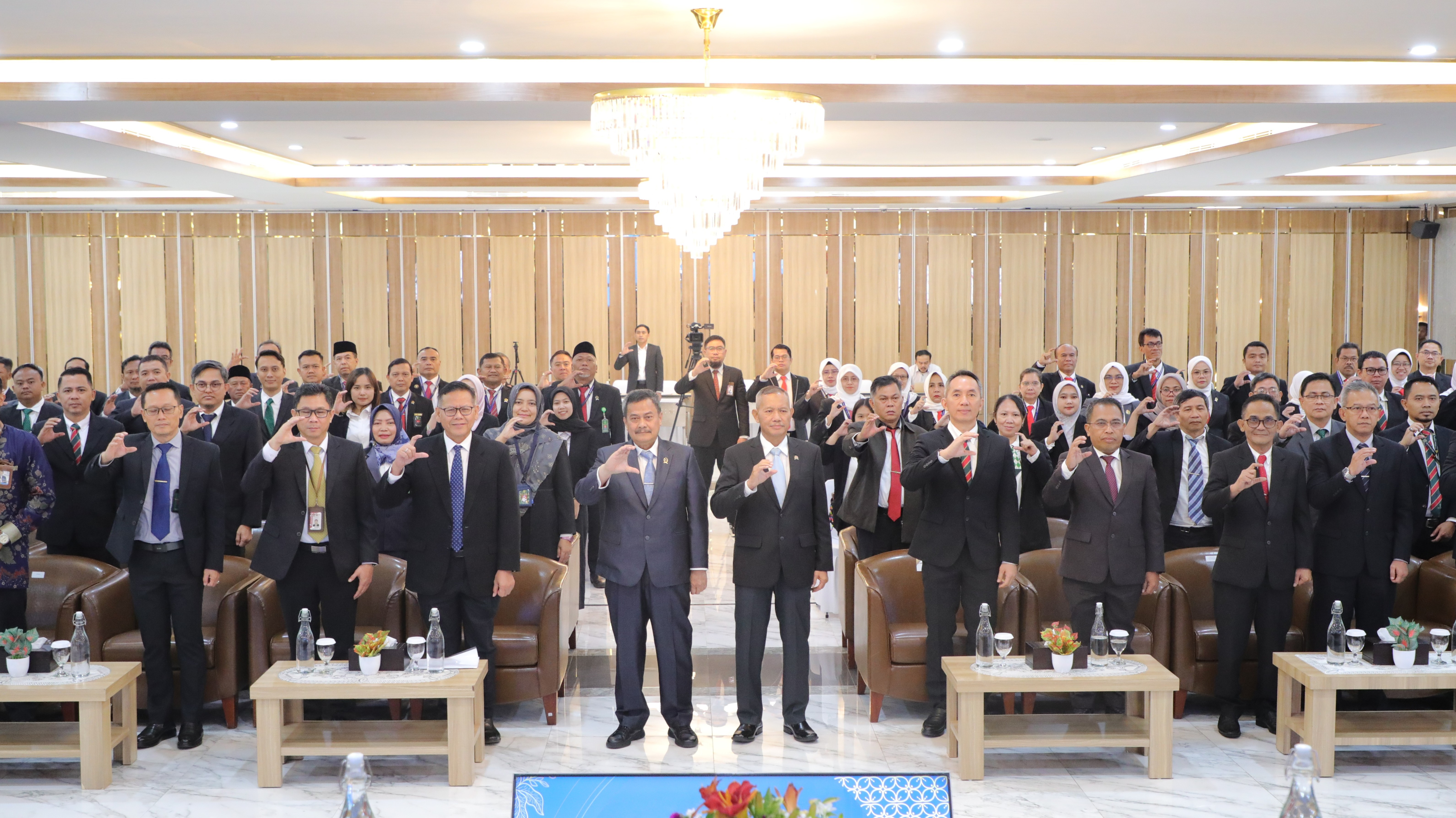
Bogor – Public Relations: The Supreme Court of the Republic of Indonesia, through the Judicial Policy Strategy Education and Training Agency (BSDK), officially organized a training program on integrity strengthening and anti-corruption for first-instance court leaders from 18 to 22 May 2026 at the BSDK Building.
The training serves as concrete evidence and a follow-up to the Joint Agreement between the Supreme Court of the Republic of Indonesia and the Corruption Eradication Commission (KPK), which was signed by both institutions on 24 April 2026.
Vice Chief Justice for Non-Judicial Affairs, Dr. Dwiarso Budi Santiarto, S.H., M.Hum., stated in his remarks that the training plays a strategic role in internalizing the values of honesty, accountability, transparency, as well as the courage to reject any form of misconduct.
“The Supreme Court is firmly committed to placing integrity as a priority in judicial reform. This commitment is not merely a slogan, but a continuous commitment realized through concrete policies,” he said.
He explained that the commitment is reflected in four main policies: strengthening internal supervision, implementing technology-based systems, enforcing the code of ethics, and strengthening cooperation with external institutions such as the KPK and the Judicial Commission (KY).
“The implementation of technology aims to minimize direct interaction and opportunities for misconduct. That is why we have developed e-Berpadu, e-Court, e-Litigation, Smart Majelis, and other digital systems. These efforts are also intended to uphold the integrity and conduct of judges and all court personnel consistently,” he emphasized.
Meanwhile, the former Head of the Supervisory Body stated that there are still several vulnerable points prone to misconduct, including case administration, public services, and case execution processes.
Therefore, the Supreme Court strictly implements a zero-tolerance policy for judicial personnel who violate integrity principles.
“There is no excuse, no compromise, no grey area, and no legal protection for any personnel within the Supreme Court and courts throughout Indonesia who violate integrity. Violations committed openly or secretly will be dealt with firmly in accordance with applicable laws,” he said.
He also encouraged all participants to use the training as momentum to reflect upon and strengthen their commitment to integrity and anti-corruption values.
“In every change, one thing that must never change is our commitment to integrity. Because integrity is not an option; integrity is an obligation, integrity is our way of life,” he stressed.
On the same occasion, representing the KPK, KPK Vice Chairman Ibnu Basuki Widodo stated that the training targets 200 court leaders across Indonesia, divided into five batches. According to him, the program is a long-term investment in cultivating integrity values.
“Forty participants in each batch demonstrate that strengthening integrity is not an incidental approach, but rather a long-term institutional investment,” he said.
Ibnu expressed hope that through the training, participants would strengthen their commitment to integrity and become role models in fostering an anti-corruption culture within their respective institutions.
“I would like to emphasize that your presence here is not merely to attend training, but to represent the future of Indonesia’s judiciary,” Ibnu concluded.
Over the next five days, forty court leaders will receive insights from speakers from both the Supreme Court and the KPK. The training materials include strengthening anti-corruption mentality, office risk management, as well as transparent, accountable, and integrity-based leadership techniques. (sk/ds/photo: end, kdr/translation: azh)


