
STRENGTHENS PROTECTION FOR VICTIMS, SUPREME COURT LAUNCHES POCKET BOOK ON RESTITUTION IN HUMAN TRAFFICKING CASES
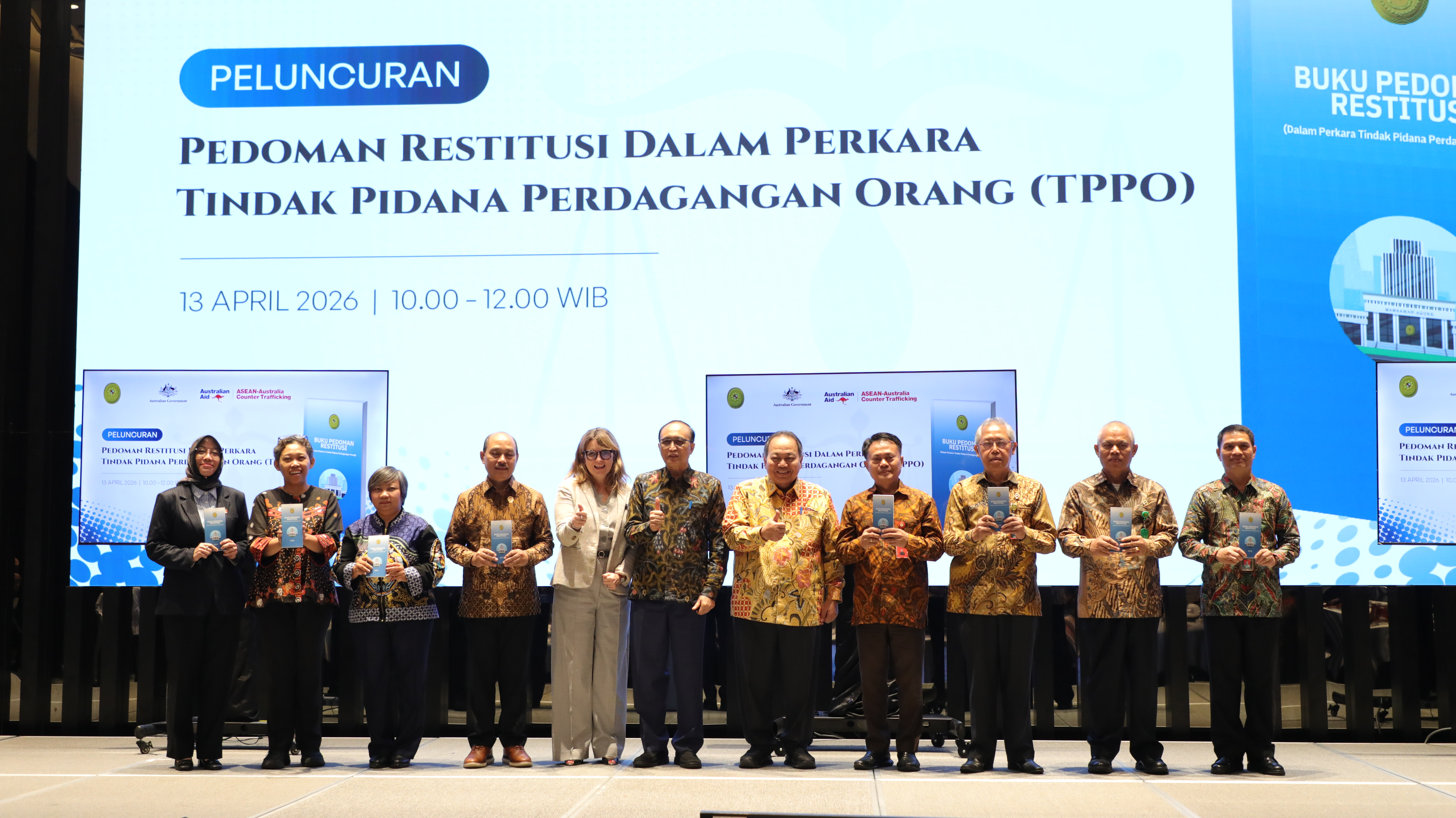
Jakarta – Public Relations: The Supreme Court of the Republic of Indonesia officially launched a Pocket Book on Restitution in Human Trafficking (TPPO) Cases in Jakarta on Monday (April 13, 2026). This initiative serves as a concrete effort to strengthen the recovery of victims’ rights, particularly women and children who are often the primary targets of this transnational crime.
The guideline was developed through collaboration between the Supreme Court of Indonesia and the Australian Government through the ASEAN-Australia Counter Trafficking (ASEAN-ACT) program and the Indonesia Partnership for Justice Phase 3 (AIPJ3).
The Vice Chief Justice for Judicial Affairs of the Supreme Court, who also serves as Chair of the Working Group on Women and Children, Suharto, S.H., M.Hum., emphasized that human trafficking is a serious crime that requires collective attention, especially as it involves women and children as victims.
“In relation to this restitution guideline for human trafficking cases, I would like to stress that trafficking in persons is a serious crime that violates human rights, degrades human dignity, and leaves deep trauma for its victims, particularly women and children,” Suharto stated in his remarks.
He further underlined that law enforcement approaches in trafficking cases should not be solely focused on punishing perpetrators, but must also prioritize victim recovery. One key instrument in this recovery process is restitution. He emphasizes that restitution is a form of state recognition of the harm suffered by victims.
“Restitution is not merely financial compensation. It is a form of acknowledgment by the state that victims have suffered losses, and therefore justice must be restored in a tangible way,” he affirmed.
Despite the availability of legal instruments, the Supreme Court acknowledged that the implementation of restitution still faces challenges in practice, starting from limited understanding among law enforcement officers to technical difficulties in calculating losses. The presence of this pocket book is expected to serve as a practical solution for judges and other law enforcement officials to encourage more victim-oriented rulings.
“This pocket book is designed as a practical guide for judges, prosecutors, lawyers, and other law enforcement officials in understanding and effectively implementing restitution in human trafficking cases,” Suharto explained.
The launch also highlights the continued existence of the Supreme Court’s Working Group on Women and Children, which has been established since 2010. Suharto noted that this guideline is a continuation of previous strategic policies, including guidelines for adjudicating cases involving women in conflict with the law and marriage dispensation.
“I hope that the Working Group on Women and Children will not stop at the publication of this Restitution Guideline, but will continue to be responsive to future developments,” he added.
The launching ceremony was attended by the Chief Justice of the Supreme Court, Prof. Dr. H. Sunarto, S.H., M.H., the Chiefs Chambers and Supreme Court Justices, the Australian Ambassador to ASEAN, Tiffany McDonald, as well as representatives from ASEAN-ACT, AIPJ3, various ministries/agencies, and appellate court chiefs. (sk/ds/RS/Photo:end,sno,alf/translation:azh)


